
Exploring My Experiences with AI
From childhood curiosity about stars to understanding the mathematics behind machine learning
Let me begin with a clarification: I'm not new to programming. What I'm doing now is different — I'm deepening my understanding so that I can explain artificial intelligence systems beyond buzzwords.
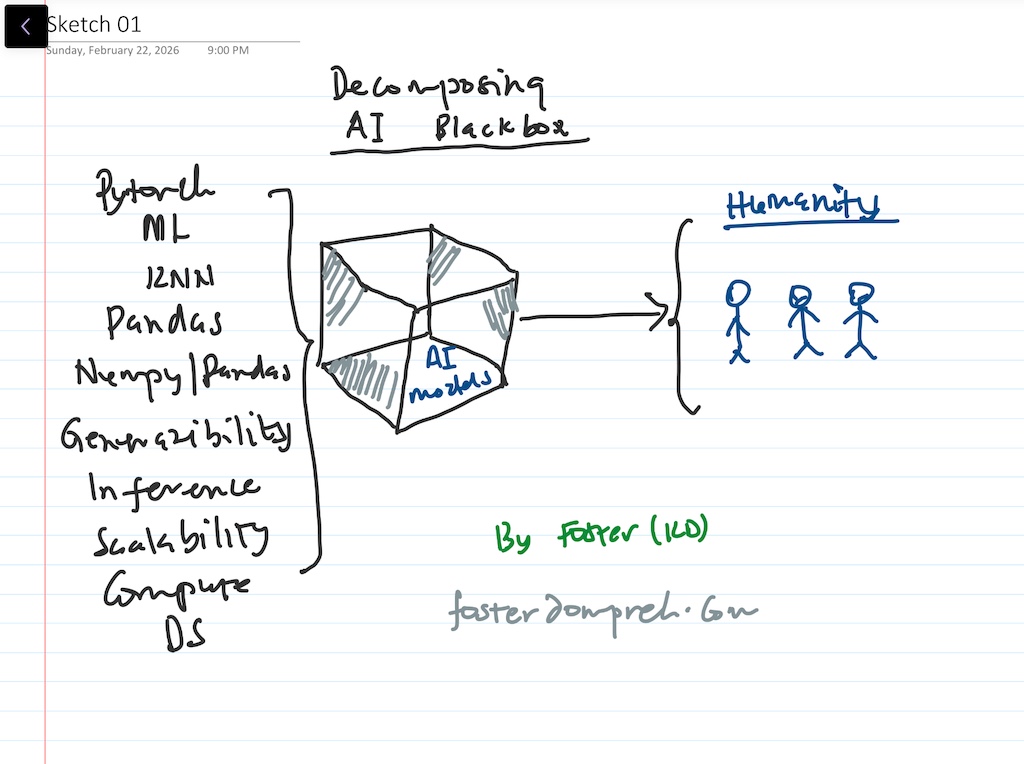
In the future, when someone asks me about the impact of AI, I don't want to respond with surface-level enthusiasm. I want to explain what actually goes into the so-called "black box." I am diving deep into the code to demystify the 'black box' of AI. I want to be able to explain not just what an algorithm does, but how it arrives at its conclusions. To understand the impact of AI, you must first understand its engine.
The Same Curiosity, Different Questions
This curiosity is not new. When I was six or seven, my father told me I used to ask him why stars don't fall from the sky — and whether I could create my own star one day. At one point, I even asked if stars got their electricity from Earth. The instinct has always been the same: I want to understand what powers the system.
AI is simply the modern version of that question.
My Recent Learning Journey
Over the past week, I've been studying Data Science and Analytics with Python to strengthen my theoretical grasp of machine learning models, particularly those powered by neural networks. Alongside that, I've been working intensively with NumPy and Pandas.
Machine learning is not just about training machines to mimic human tasks. It is about structured decision-making at scale. When billions of dollars depend on algorithmic outputs, speed alone is not enough — accuracy and robustness matter. The cost of model failure can exceed the cost of human error.
Three Key Observations
Three observations have stood out in this process.
First: Machines Speak Numbers, Not Words
NumPy reveals a fundamental truth: machines do not understand words — they understand numbers. Even natural language processing begins with translation. Text must be encoded into numerical representations before any model can interpret it. Behind every chatbot response lies mathematics.
Second: Data Preparation Is Foundational
Pandas has shown me that data preparation is not glamorous, but it is foundational. Real-world data is messy — inconsistent formats, missing values, irregular structures. Cleaning data efficiently, whether through vectorized operations or regular expressions, is not a minor task. It is the difference between a model that works and one that fails.
Third: The Black Box Is Not Magic
I am beginning to see that AI is less mysterious than it appears. The "black box" is not magic. It is linear algebra, probability, optimization, and structured logic layered together at scale.
The Deeper Lesson
The deeper lesson for me is this: learning AI is not about memorizing libraries. It is about understanding systems — how data flows, how models learn, and where errors emerge.
The same child who wondered about stars is now asking: what powers intelligence itself?
And this time, the answer is mathematics.
From Stars to Systems
I started this journey asking if stars were powered by Earth's electricity. Today, I know they aren't—but I've discovered a different kind of power in the way we structure data and algorithms. By mastering the math and the code (the 'how'), I can finally explain the 'why' of the AI revolution.
My goal isn't just to build models that work; it's to build models that are understood.